Electroscope
An electroscope can be used to get an idea of how much electrical charge is on an object. By itself, it can't tell you if an object is negatively charged or positively charged, or give you a numerical value for quantity of charge but it will tell you if it is charged. If you have two charged objects, it may tell you if one is more charged than the other, based on how much the leafs in the electroscope move apart. The video below has an example of this.
To tell whether an object is positively charged or negatively charged you'll need to learn how to inductively charge an electroscope. See below about that.
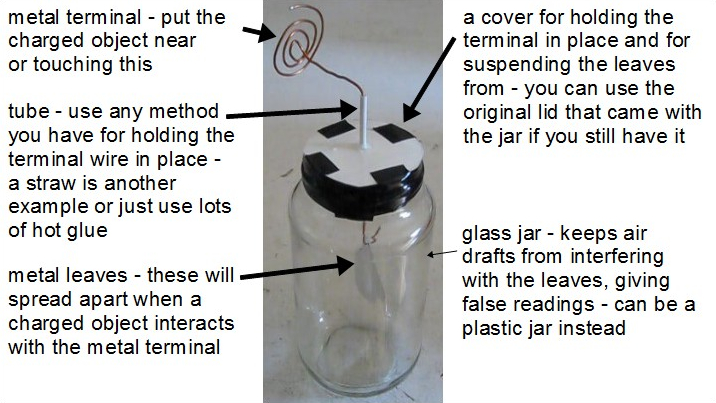
Here's how it works...
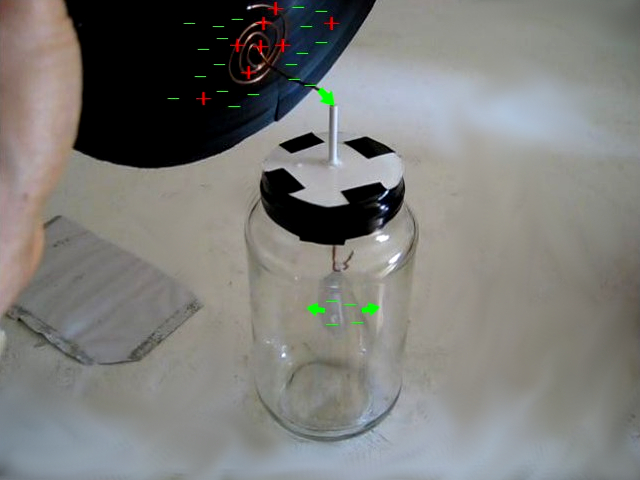
Initially there are around the same number of negatively charged electrons (-) and positively charged protons (+) on the terminal. But the vinyl record has far more negative electrons than positive protons so we say it's negatively charged. When the negative vinyl is moved close to the terminal, the electrons on the vinyl repel the electrons on the terminal. This is because like charges repel each other. In this case negative is repelling negative. This leaves mostly positive protons on the terminal while the negative electrons are repelled down the wire and to the aluminium foil leafs. The leafs are free to move around a bit and since they are now both negatively charged, they repel each other. That's how we know that the vinyl record is charged. If the vinyl record had an equal number of positive and negative charges then this would not happen.
As you can see, an electroscope is a quick and easy DIY project that can be made at home with household parts. The leafs in the above one are made with aluminium foil from the kitchen, the plastic top is cut from the plastic cover from a plastic container though you can use the original lid if you still have one and can find a way to poke a hole through it (I no longer had the original lid). A key point is that the terminal must be electrically connected to the leafs. In this case the terminal is a part of the wire that extends down into the glass jar, and that wire forms a hook which the leafs hang from.
The following is a video giving a demonstration of all this.
How to inductively charge an electroscope
The following is a video demonstrating how to inductively charge an electroscope such that the electroscope will keep its charge even after you move the charged object away from the terminal.
After inductive charging, the electroscope will have the opposite charge of the object. If the object was negative then the electroscope will be positive and vice versa. To find out whether the object was positive or negative, look in the triboelectric series table.
How to determine whether something is positively or negatively charged
To do the test you first need to inductively charge the electroscope either positively or negatively (see the above section for how.) The following table summarizes what happens when you bring your test object near the terminal of your electroscope, what will happen to the leafs and what charge that means the object has.
| Electroscope is charged... |
What the leafs do... | The object is charged... |
|---|---|---|
| positively | move closer together | negatively |
| positively | move farther apart | positively |
| negatively | move closer together | positively |
| negatively | move farther apart | negatively |
The following subsections explain the above in detail.
Using a positively charged electroscope
If you inductively charge an electroscope so that it's positive and when you bring an object close to the terminal the leafs move closer together then the object is negatively charged. That's because the object repelled electrons down to the positive leafs, making them less positive and causing them to repel each other less.
If on the other hand the leafs move farther apart then the object is positively charged. That's because the object attracted electrons from the leafs making them more positive, which causes them to repel each other more.
Using a negatively charged electroscope
If you inductively charge an electroscope so that it's negative and when you bring an object close to the terminal the leafs move closer together then the object is positively charged. That's because the object attracted electrons from the negative leafs, making them less negative and causing them to repel each other less.
If on the other hand the leafs move farther apart then the object is negatively charged. That's because the object repelled electrons down to the leafs making them more negative, which causes them to repel each other more.
Video demonstrating determining charge polarity
This is a video I made demonstrating using this electroscope to determine charge polarity using a cathode ray TV tube as the example.
Electrostatics and magnetism misconception - and more electroscope demonstrations
Around May 2012 I realized there was some misconception spreading around the internet that if you bring a magnet close to the leafs of an electroscope then the magnetic field will have some affect. This is false. The magnetic field doesn't play a part but the leafs are affected due to simple Coulomb forces alone (attraction or repulsion of electrons.) I made the following video with animations to explain what actually happens and why.
At the same time I explain more things about charge and the use of electroscopes.
