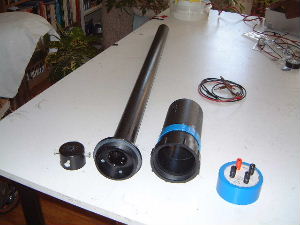
The final step was to make a tube out of PVC tubing that the resistor
chain could slide into and be secure.
The tube was made of four components. Going from left
to right they are: the endcap for the probe tip, the long narrow tube for most
of the chain, the short thick tube for the part of the chain that has the
corona gaps and the end cap with the connectors. Also shown in this picture
are some banana plug patch cords.
 |
|
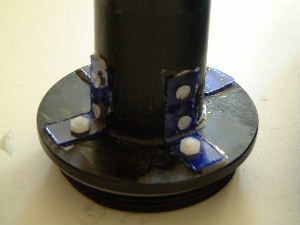
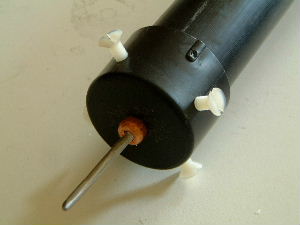
Construction details of the part of the long narrow
tube that connects to the short thick tube. The wider disk screws into the
short thick tube. I epoxied these two parts together and then added the
plastic L parts for added safety in case the epoxy ever fails. I used
nylon bolts to bolt the L parts into place (epoxy didn't work well for this).
 |
|
In hindsight (thanks to Zoltan for pointing it out) I should have used
PVC glue instead of epoxy. "The special PVC glue is not more expensive
than the epoxy and usually it can be acquired from stores where the PVC
pipes are sold. The epoxy does not make a very firm bound with the PVC.
But the special PVC glue makes a perfect `welding' because it is made of the
same PVC material solved up by some chemical. When the solvent
evaporates, a perfect bond remains since the `glue' now became the
same PVC as the pipes have been made of." - Zoltan. I would still have
added the L parts (or PVC triangular pieces) for extra safety.
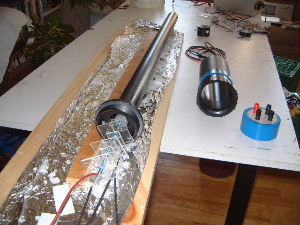
Carefully inserting the chain into the long tube. Note
that I'd already soldered all the wires onto the chain.
 |
|
I then screwed on the short tube.
 |
|
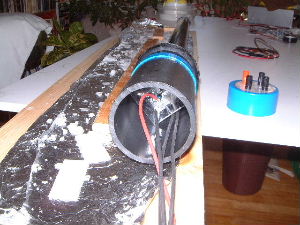
I then slid the probe tip endcap into place and
tightened the nylon bolts. The nylon bolts make contact with the .5"
copper rod and hold it firmly in place.
 |
|
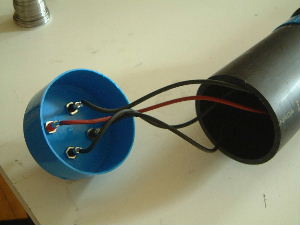
I was probably being silly but I decided to have separate connectors for
the ground wires coming from the corona gaps and have these separate from
the connector for the probe ground. Really these wires should probably
all be soldered together and I should have just one ground connector.
I soldered the wires to the connectors on the endcap.
 |
|
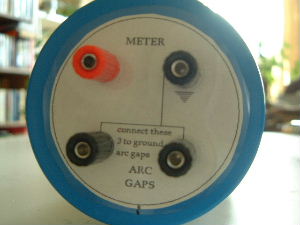
View of the endcap in place. Note the separate
connectors for each corona gap (labelled as ARC GAPS).
 |
|
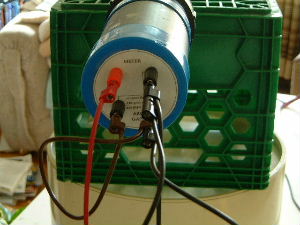
Note the complicated wiring using banana plug patch
cords. The reason is that I'm plugging the two ARC GAPS together and then
plugging them with the ground plug. The end result is just two ends for
connecting to the meter.
 |
|
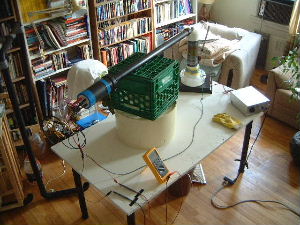
The probe in place for testing. During the test
everything was quiet, all the way up to 75kV (see scope tests below)!
Practically no leakage since all HV connections were either insultated
or not leaky. It was very spooky to watch a system with such high
voltage be so quiet.
 |
|
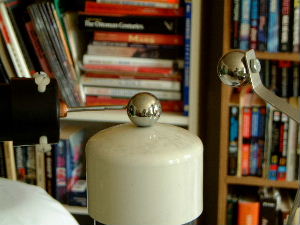
The probe tip in contact with the positive ball on
my power supply. Note that I've bent the attachment to the ball on
the right so that the bar is no longer on top of the ball.
 |
|
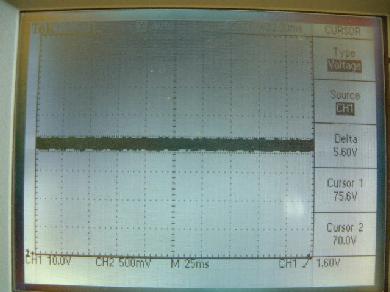
75kV with no hissing or clicking but with some high
frequency sound.
 |
|
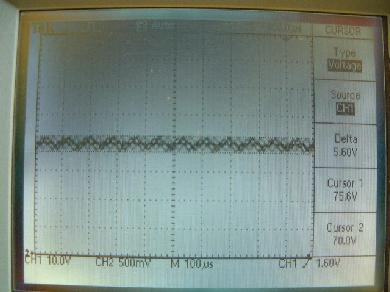
Another measurement of 75kV, different sampling rate.
 |
|
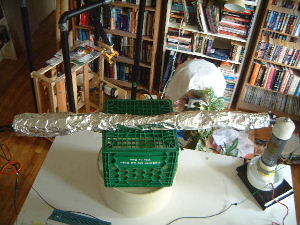
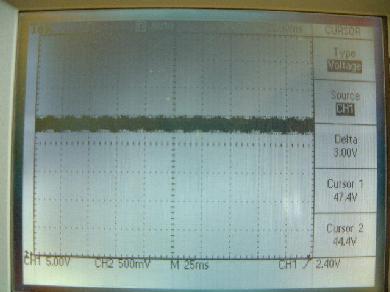
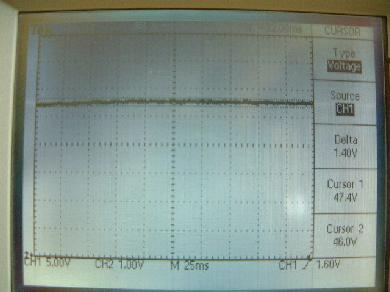
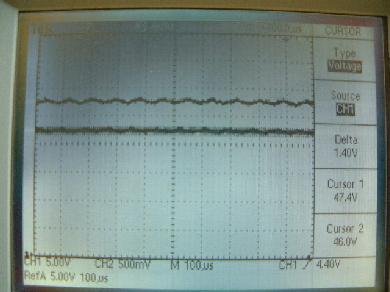
At Zoltan's request I tested how much of the 60Hz signal I would see
with the probe shielded (wrapped in grounded aluminum foil). I expected
to see no change since I was expecting most of it to come from the
other wiring in the system. I was wrong. As the probe snapshots below
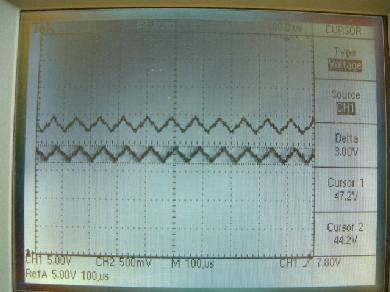
show, most of it disappears. Note that the 12kHv signal is still there.
Note also that with the foil I could go only up to around 50kV before
the edge of the foil nearest the probe tip arced with some part
inside the probe (probably the copper rod). So measurments below with
foil have been restricted to 47kV.
Probe wrapped in grounded aluminum foil.
 |
|
The 60Hz signal without the aluminum foil shield (cursors
measuring peak to peak).
 |
|
The 60Hz signal with the aluminum foil shield.
 |
|
The 12kHz signal without the aluminum foil shield. The
top trace is a saved one. The bottom trace is the live one.
 |
|
The 12kHz signal with the aluminum foil shield.
 |
|