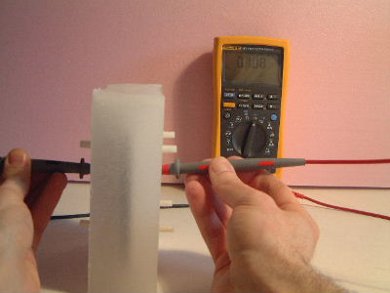
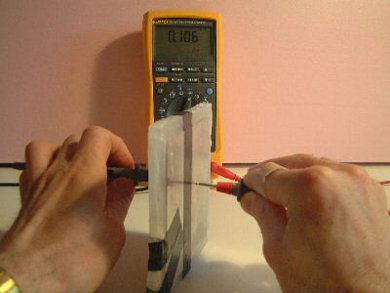
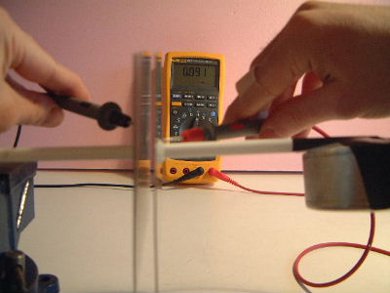
This method of construction lead to a less than good measurement.
During drying of the wax there was shrinkage that went right down to
between the electrodes. This meant having to pour more wax to fill
in the gap. This lead to layers between the electrodes and to a
breakup of the wax during carving.
The dielectric constant as determined by the method below is: 1.16.
Due to the breakup of the dielectric, this result is useless.
1.16 is the capacitance of the wax capacitor (0.106 nF) divided by the
capacitance of the air capacitor (0.091 nF).
The test was made using a parallel plate capacitor where the plates
were aluminum of dimensions .8mm x 101.6mm x 101.6mm. The spacing
between the plates was 7mm. To calculate the dielectric constant
two capacitors were made: one with paraffin wax for the dielectric,
the other with air for the dielectric. The dimensions were the same
for the both capacitors. The capacitance of each was measured using
the capacitance measuring feature of a Fluke 187 True RMS Multimeter.
The three measurements made are detailed in the pictures below.
The idea was to have fine control over the distance between the
electrodes without interfering with the dielectric in between.
This was done by holding the plates in position using suction
cups where the suction cups were holding from the outer sides
of the capacitor's electrodes (plates). See pictures below.
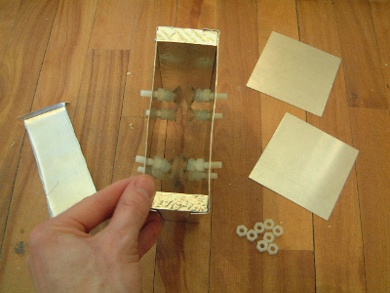
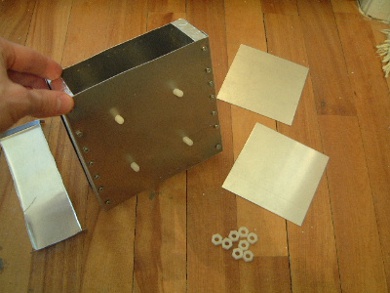
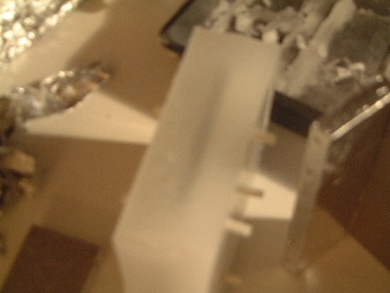
Looking inside at the suction cups that will
hold the plates. The plates are on the right sitting on the floor.
Each suction cup is made of plastic and is epoxied to the head of
a nylon bolt. The part to the left is the base.
 |
|
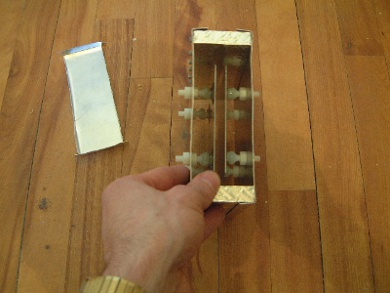
A view showing the nylon bolts sticking through
the mold wall.
 |
|
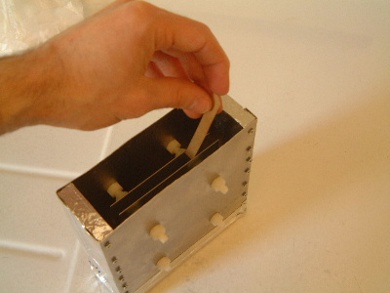
The plates now inside the mold, held in place by
the suction cups. The spacing between the plates is 9mm though due to
the pressure of the wax the final spacing may be different.
 |
|
The spacing was measured by cutting a piece
of cardboard 9mm wide. Note that the cardboard was actually used
while the plates were being attached to the suction cups (i.e. before
the picture to the left was taken) but I didn't think to take a picture
at the time and now that the base was attached I wasn't about to
detach it for a photo.
 |
|
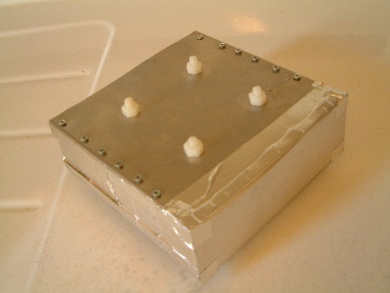
This shows the base attached using aluminum tape.
The aluminum tape is the best I've found for working with liquid wax
due to its ability to take the heat. However, it is not ideal. In fact
the tape in this picture allowed to wax to leak and I had to retape it
much more and even that leaked somewhat!
 |
|
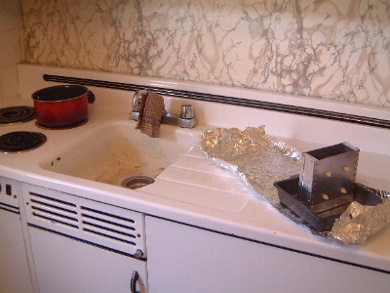
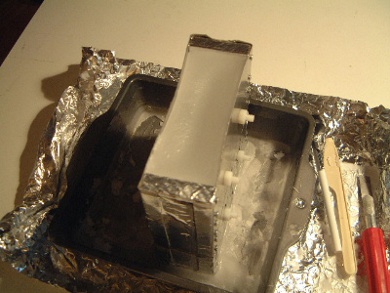
The area where I poured the wax. The wax was
melted on the stove on the left.
 |
|
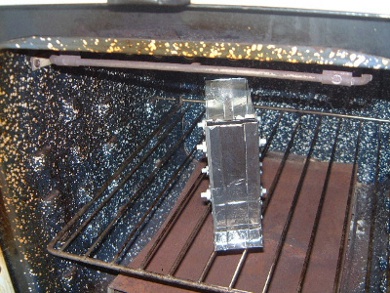
The mold heating up in the oven. I wanted it to
be hot so that there wouldn't be too much of a difference in temperature
between the mold and the wax. This was to get more even cooling around
the electrodes.
 |
|
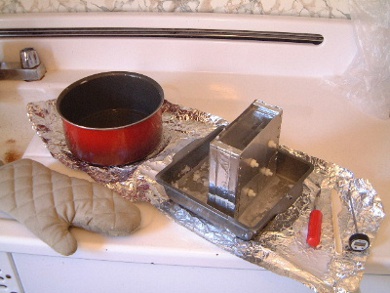
The complete set of tools for the pouring. Note the
digital thermometer on the right. The mold actually leaked at about
half height. I had to wait a while for it to cool to about 62 degrees C
before pouring in the rest.
 |
|
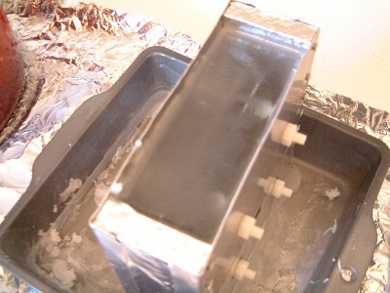
The filled mold when it was starting to solidify.
Note that due to the shrinkage that happens when solidifying the wax
gradually formed a deep depression that went all the way down to about
2mm below the height of the electrodes. I then topped it off with
some more hot wax.
 |
|
The topped off wax. This is taken the next day.
 |
|
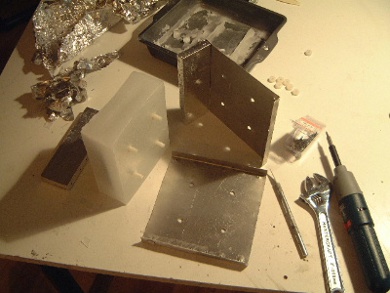
The complete thing after disassembly. The wax block
is beautifully smooth with no sign of bubbles, cavities, of cracks within
it. My best ever. This was probably due to the preheating of the
electrodes and the hot starting point of the wax.
 |
|
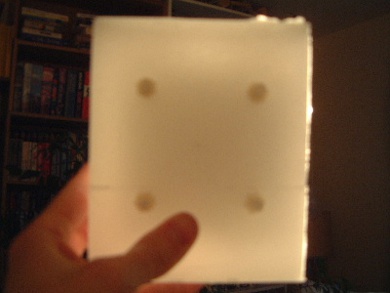
View with a light behind it to show the electrodes
within.
 |
|
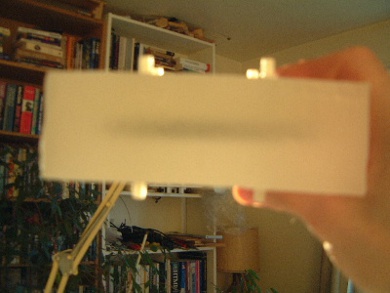
Side view of the electrodes in the wax.
 |
|
Another view of the electrodes in the wax.
 |
|