Solar Thermal/Hot Water Heater (also Solar Domestic Hot Water (SDHW))
Solar thermal and solar hot water most often means using solar energy and a solar system to heat water for taps, laundry, dish washing, ... In relatively cold climates such as in Canada, it saves around 50% on your hot water heating bill year round (35% in summer, 65% in winter.) In most cases you'll still need a backup heating system (electric, natural gas, ...) Solar thermal supplies heated tap water at around 50C (120F.) The payback time if you buy a commercial system is roughly 8 to 10 years: 8 years with electric heating for backup, 10 years for natural gas. The payback if you make your own DIY solar hot water system is much shorter of course. Solar thermal systems are also sometimes called Solar Domestic Hot Water (SDHW), which is actually a far more precise name.
DIY/homemade solar domestic hot water systems

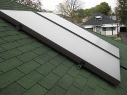
Flat panels and vacuum tubes solar collectors
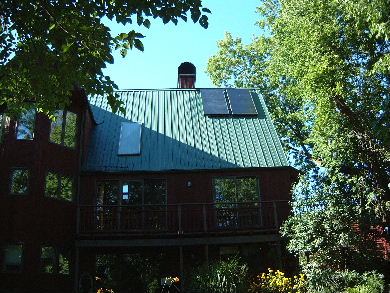
Note: Photos on this page are of actual installations I was involved with while working for Ottawa Solar Power unless specified otherwise.
The following are the two types of most used solar collectors for solar thermal in cold climates such as Canada's: flat panel and vacuum tube (also called evacuated tube.)
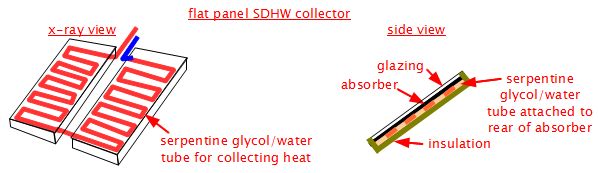
Flat panel solar thermal
Vacuum tube (evacuated tube) solar thermal
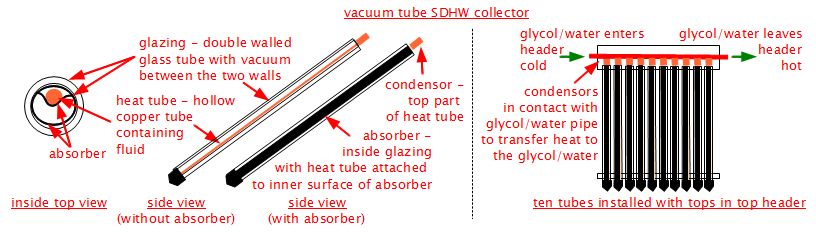
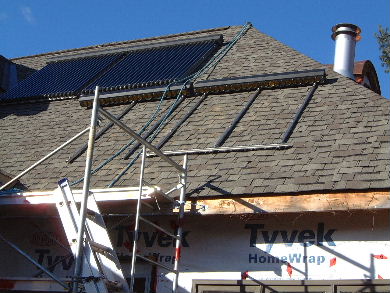
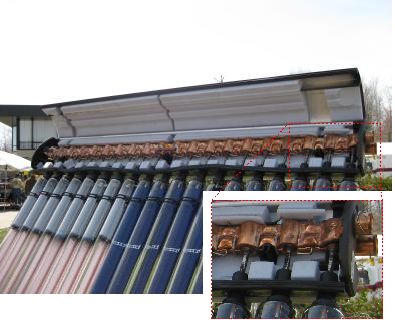
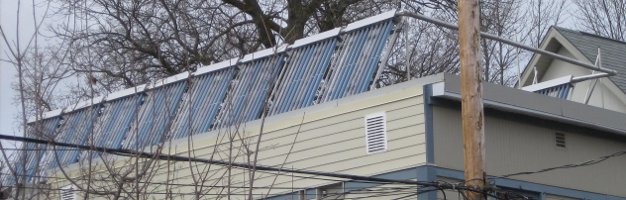
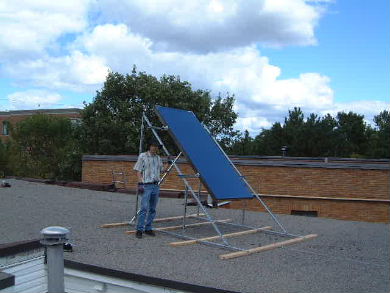
In a climate where snow might accumulate on roofs, make sure the evacuated tubes are raised up off the roof. Evacutated tubes are so efficient that even though the heat tube inside may be hot, the exterior of the tube will still be cold. Snow will not melt off. So make sure the tubes are raised higher than snow will pile up, as in the photo on below.
Note that this is not as much of an issue with flat panels because they are less efficient. Their outer face will warm up when there is sun and eventually melt snow.
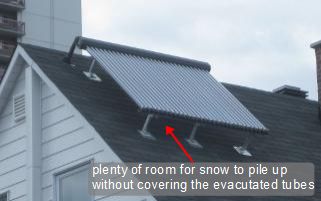
The flat panel collectors tend to be a little less efficient than the vacuum tube systems but cost a little less. An example of a flat panel system is the EnerWorks system. An example of a vacuum tube system is Apricus system.
How solar thermal/solar hot water works
The following are the major parts of a system. This example uses the EnerWorks flat panels and arrangement of pipes. You can replace the flat panels in the diagrams with vacuum tubes and it would still work. For details and photos of an installed Enerworks solar thermal system see here.
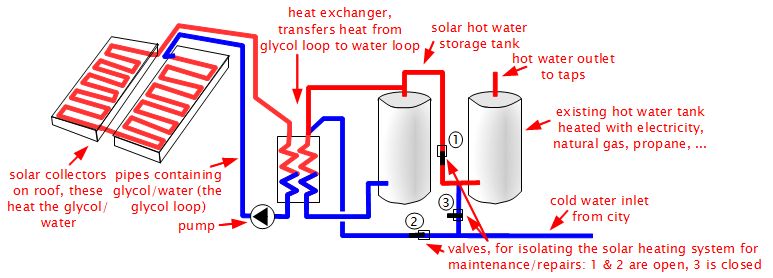
On the left are the solar collectors. In the middle is the heat exchanger. On the right of the heat exchanger is the water circulation section. The pipes that go to the solar collectors contain a mix of propylene glycol (~50%) and distilled water (~50%), totaling about 14 to 20 litres. This is because they are outdoors and glycol won't freeze in winter. The glycol/water mix gets heated and carries its heat to the heat exchanger. There it transfers its heat to the water pipes (which are indoors.) Notice that there are two water tanks. The solar hot water storage tank contains water heated by the solar system. The other tank is heated by a more common means and acts as a backup.
Propylene glycol is food grade glycol and as such is relatively safe. Notice that in the above diagram, the fluid from the glycol/water loop does not mix with the water in the water tanks. Only the heat is exchanged. However, just in case the heat exchanger breaks and allows the glycol to get into the water tanks, a back flow preventer valve (not shown above) is installed on the cold water inlet from the city, preventing the glycol from getting into the city water system.
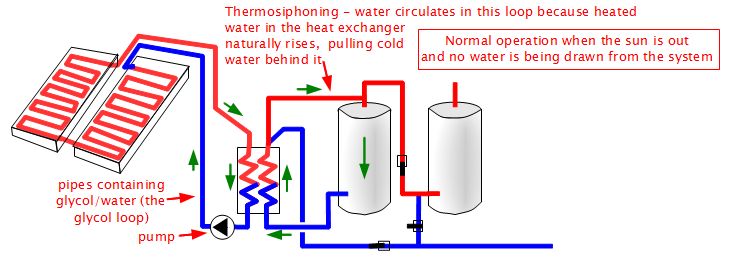
The following is what happens when the sun is out and no water is being drawn from the system. Notice the thermosiphoning that goes on to keep the water circulating and taking heat from the heat exchanger.
The following diagram shows what happens in an EnerWorks system when hot water is drawn from a tap. Key to understanding is that that when water is being drawn out, new water must be pulled in to replace it. This new water is cold water from the city. In many systems that cold water is pulled into the lower area of the solar storage tank. In the case of an EnerWorks system, that cold water is first run through the heat exchanger primarily to clean out any contaniments that may have accumulated over time. Other systems typically just draw the water directly into the lower area of the solar storage tank.
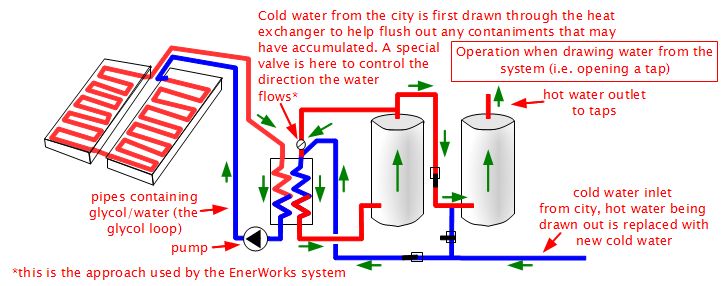
Temperature sensors mounted in the panels and in the solar tank are used by an electronic controller to determine when to turn the pump on and off.
Why use two tanks instead of just one?
The easiest way to understand why is to imagine you have just one tank. The thermostat for your electric, natural gas, ... or whatever heating system will want to keep the temperature of the tank up to around 50C (120F). So at night it will do this and in the early morning. By the time the sun comes up the water in the tank is already hot. The solar heating system controller will see that the tank is already hot and even if there is plenty of heat in the solar collector, it will not bring that heat down to the tank. Your solar system will rarely run.
Maintenance
Every manufacturer's system has differences and the location and installation introduce differences so your installer will fill you in on the exact parameters and maintenance for your system. The following will give you some idea.
- Cleaning solar collectors - For flat panels, this should not be necessary as the panels should be mounted at a steep angle and rain will wash them off. Snow will melt off them when the sun comes out both due to the sun's heat and the heat from the panels. For vacuum tubes, rain will wash them but snow will not melt as well as with flat panels. This is because the outside of vacuum tubes stay relatively cool, so it may be necessary to bush snow off in winter. Brush it off with a broom, not a shovel.
- Glycol loop fluid pressure - In general this would be around 40 psi (pounds per square inch) or 5 to 10 psi above the static head (height from the pressure gauge to the highest point on the panels divided by 2.31.) Check every few weeks after the system is first started. Then gradually check less frequently. In the end, twice a year is probably good enough.
- Glycol replacement - The propylene glycol/distilled water mix deteriorates over time, mostly due to stagnation. Stagnation is when the fluid is hot and not moving. This can occur on sunny days when no hot water is being drawn from the taps. For vacations, something called a vacation bypass valve is usually installed which will allow thermosiphoning to occur in the glycol loop thereby allowing the fluid to move even if the pump is off. EnerWorks has some additional technology built into their panels to help prevent overheating. In general, if your system has not stagnated then it can last 15 years. Many manufacturers recommend replacing the distilled water/propylene glycol mix every three years.
- Hard water systems - If you have hard water then it's a good idea to drain a little water from the bottom of the solar storage tank every now and then to get out any sediment that may have collected there.
Finding a Location
Both flat panels and vacuum tubes are mounted either on the roof, on a rack on the ground or on a rack on a wall. If on a roof then you'll need room for it. The collectors should preferably face south but can also be south-west or south-east. Apricus vacuum tubes are more forgiving with this due to the round shape of the tubes and the round shape of the absorber within the tubes. The absorber of a flat panel is flat and faces one direction only whereas the roundness of the Apricus absorber means it faces more than one direction. Relfection off the glass tubes also helps distribute the sunlight. There must be no shade for the bulk of the day (e.g. 10:00am to 3:00pm.) Different angles are suitable for different times of year. A SDHW system can produce so much heat in the summer that often the collectors are left at a winter angle all year round.
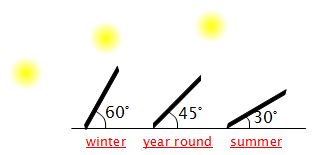
The above angles are for a latitude of around 45 degrees north or south. For a winter angle add 15 degrees from your latitude. For a summer angle subtract 15 degrees to your latitude.
