Solar power - How it works 2 - Solar panels to inverter
Most systems don't use the energy directly from the solar panels. This is because the sun isn't always shining. Instead the energy is stored in batteries and then taken from the batteries whenever needed.
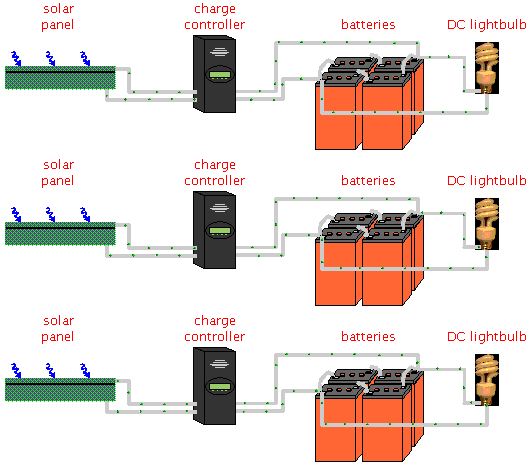
Putting the energy into the batteries must be done in a controlled manner using a charge controller. If not, then at night the batteries would dump their energy back into the solar panels. You also don't want to overcharge your batteries. Charge controllers handle these problems and more.
Notice in the above diagram that on all the wires, the electrons are moving in one direction only. This is called DC, or Direct Current, electricity. The DC lightbulb works fine in this case but not all appliances will. Some work only if the electrons are moving back and forth as the following diagram illustrates. This is called AC, or Alternating Current, electricity. Notice that in both cases we still have electricity since electricity is defined as electrons moving in a wire, and back and forth motion is still moving.

The problem is that appliances work either with DC or with AC. Anything that plugs directly in to a battery is using DC; batteries supply DC electricity. Anything that plugs into a wall socket, which is most everything in your house, is using AC; the electric utility company uses the power grid to send you AC.
To solve this problem, use an inverter. An inverter converts DC electricity to AC electricity. In the following diagram, the inverter is converting DC electricity from the batteries into AC electricity and sending it to the AC lightbulb, the type used in just about every house. You can tell this because the electrons on the wires going between the inverter and the lightbulb are moving back and forth.
Note that this inverter is also capable of charging batteries and is taking AC electricity either from the power grid or from a generator and using it to charge the batteries.
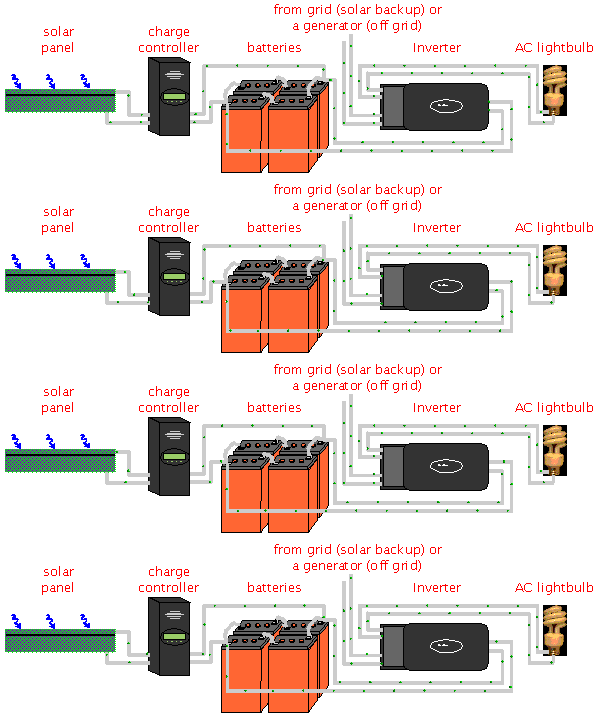
Some inverters put out AC electricity in the form of a pure/true sine wave and some put out AC electricity in the form of a modified sine wave. Some appliances will not work with modified sine wave inverter. For more details about this see this page: Pure/true vs modified sine waves and inverters.
Detailed video explanation of an off-grid system I helped install
Here's a tour of an off-grid system I helped install (with Ottawa Solar Power) along with diagrams and explanations of how it works.
