Solar power - Types of systems
Quick clarification... Being on the grid means you are connected to the power lines, a power utility that's supplying power from hydroelectric, nuclear, coal generators, natural gas generators, ... Here in North America we refer to the complex web of power lines and power generating systems as "the grid". Being off the grid means you have no external source of power, you are not connected to the power lines, your only source of power is your own solar, wind, micro-hydro or small generator.
Off-grid
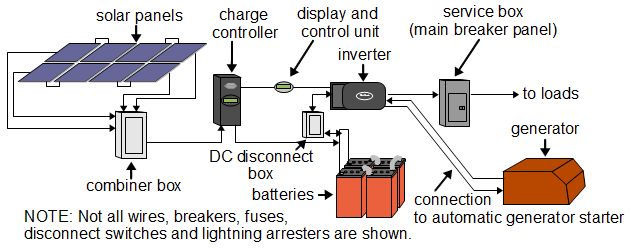
This involves getting power from solar power with an optional generator as backup. See the diagram below. Instead of a connection to the grid, there can be backup power from a generator for when there are too many cloudy days in a row. Optionally the generator can be started and stopped automatically based on the battery voltage. In the diagram below it is a feature of the inverter. If your inverter doesn't have this feature, separate automatic generator starter units are available. Automatically doing this is better than having to run out and start the generator manually when the batteries get too low for two reasons: convenience and you don't want your batteries to go below 50% (without an automatic starter, you'd have to constantly be checking the battery voltage.) As an aside, the diagram below also shows a separate display and control unit, often available depending on the manufacturer of the charge controller and inverter.
For far more detail see the dedicated section on off-grid solar power including how system design and maintenance information.
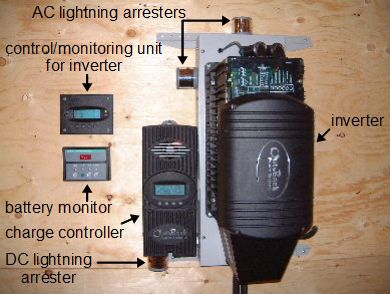
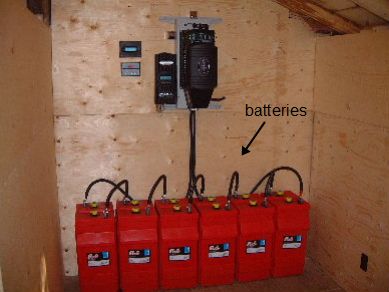
The following photos show a typical system. Most of the wires have been run behind the wall and enter the components from their backs to prevent someone from accidentally hurting themselves.
You'll also notice some things called lightning arresters in the photo on the left. These protect the various components from lightning strikes. If lightning hits a solar panel then the very powerful electricity from the lightning could travel along the wires going between the solar panels and the charge controller and damage the charge controller. For this reason an DC lightning arrester is connected to that wiring and is shown at the bottom of the photo. Similarly there are AC lightning arresters used in case lightning strikes the generator or the wires coming from the generator and in case lightning strikes the household wiring.
The following is a detailed video tour of a completely off-grid home with a large solar system and a backup generator.
For far more detail see the dedicated section on off-grid solar power including how system design and maintenance information.
Feed-in tariff (or solar premium)
This involves selling power to the grid and getting paid for that power. It is essentially being a mini-power utility. Due to the high cost of solar panels, the amount paid by the power company is usually above cost.
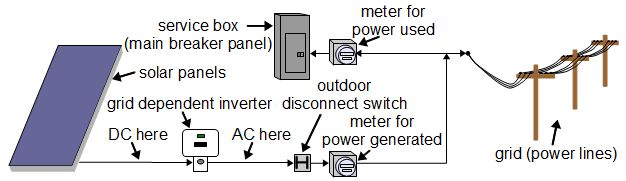
One example of this is the microFIT/FIT Feed-in Tariff program In Ontario, Canada. Here the average consumer can pay around $0.20 per kWh for electricity (total bill amount/kWh used.) The Ontario Feed-in Tariff program pays up to $0.549 per kWh.
Net metering
This involves feeding power to the grid and using power from the grid, paying for only the difference. Notice from the diagram that there are no batteries and so no storage of power. If there is a power failure on the grid then the inverter stops supplying power, even though you still have solar panels.
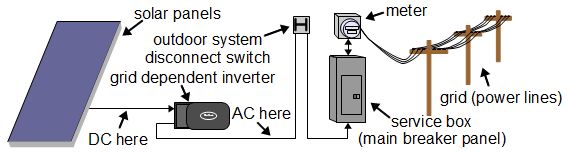
You can find full details on this dedicated net metering page, including how net metering works, system details and calculations for how long until you reach payback.
Solar backup (or grid interactive)
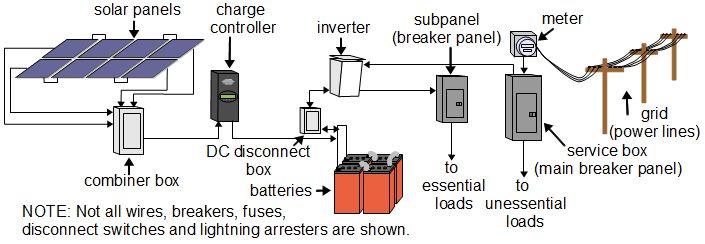
This involves getting power from the grid and using solar power and/or other renewable energy sources, such as wind and microhydro, as backup. See the diagram below. The inverter is fed power both from the grid (through the main breaker panel) and from batteries. An extra breaker panel, refered to as a subpanel, is installed. The subpanel feeds the loads you need even when the grid goes down (essential loads). While the grid is up, the subpanel is fed through inverter from the grid. When the grid goes down, the subpanel is fed through the inverter from the batteries. This switchover is handled automatically by the inverter. The batteries are kept charged from the solar panels (through the charge controller) and from the grid (through the inverter, as it contains a charger too.)