Realizing this probably won't work but that it'd be fun to build and try
(I was right :-)), I
built a permanent magnet motor based much on a water wheel. The idea was to
have magnets on the periphery of a wheel, with the magnets arranged such that
a push force on them would impart torque on the center of the wheel.
Even though this didn't work, it illustrates a useful trick you can do with
steel to shape the magnetic field.
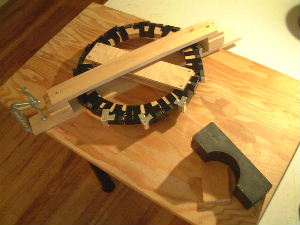
All magnets have the same side facing out (e.g. all
north faces facing out). The large magnet on the right is what I use
to cause the wheel to turn by moving it close to the edge of the
magnets on the wheel. It will be in repulsion.
 |
|
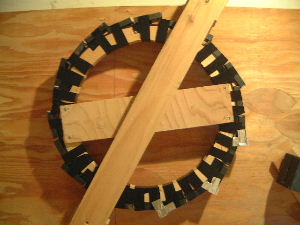
Idea was to have as much of the face of the magnet
exposed with only a little overlap where the magnets meet.
 |
|
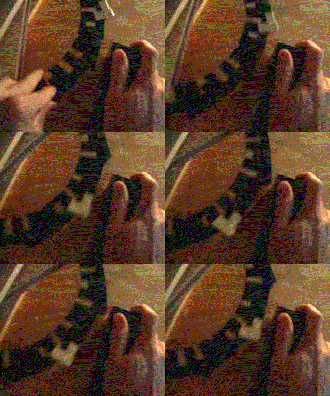
A problem is that as the magnets repel, at some point they get stuck.
In this case it's because of additional repulsion encountered with
one of the magnets that stick out far enough. See the following animation.
When I release the wheel it starts to turn due
to the repulsion by the large magnet on the right. But it eventually
gets stuck.
 |
|
To fix the above problem a keeper can be used. A keeper is a piece of
metal that is often used with horseshoe magnets to help
them keep their magnetic properties longer. The keeper is put across
the ends of the horseshoe magnet so that the field will go from the north
of the magnet, and through the keeper instead of through the air, to the
south of the magnet. In this case I am using the keeper more for
shaping the field so I should call it a shaper.
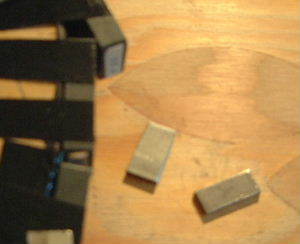
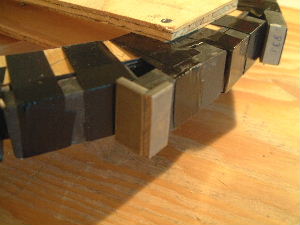
The two pieces of steel on the right are my shapers.
 |
|
I want as little of the field to extend out into
the air as possible. So I put the shapers wherever I want to pull
the field back in. Instead of going out into the air, it will go
through the steel shapers.
 |
|
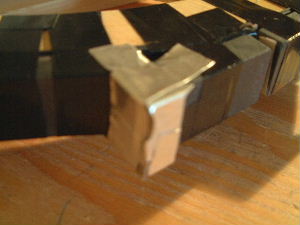
My large repelling magnet will come close to
the shapers and since they are steel, it might pull them onto itself.
So I tape the shapers in place with plumber's aluminum tape. This
is wonderfully sticky and strong.
 |
|
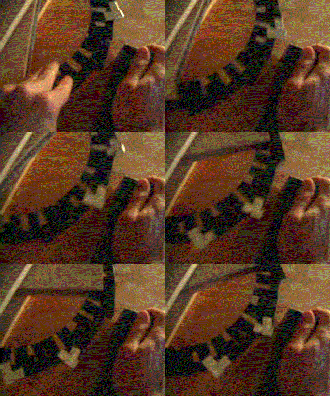
And now...
Before attaching the second set of shapers (same
animation as above)...
|
|
... and after attaching the second set of shapers.
Notice that the wheel moves further.
 |
|
Unfortunately, I added a third set of shapers on the next set of
magnets but the wheel would not go past them. The potential energy
present before releasing the wheel to start it turning, which turned
into kinetic energy in order to add a little extra to the repelling
forces was not enough to make it go farther. The magnets themselves
did not introduce any new energy.


