This details the various barium titanate (BaTiO3) capacitors that
I've made over the years for my research to do with
non-conventional propulsion and
non-conventional energy. The
need for a cylindrical capacitor was driven by my experiments in
vacuum energy to
electrical energy conversion.
The primary usefulness of barium titanate is in its high dielectric
constant. For my use this is desirable because it allows me to do
electric field shaping with reasonable high voltages across the capacitors.
Its dielectric constant (K) varies according to temperature and
electric field strength.
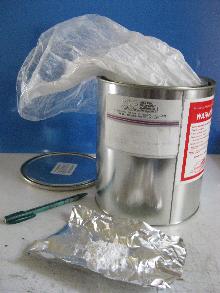
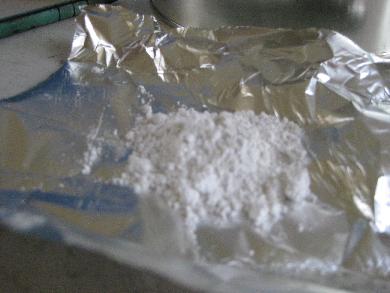
I purchased 12 lbs of BaTiO3 (product no. BA-901) from Atlantic Equipment
Engineers in about mid 2002. It arrived in a 1 gallon can containing a
plastic bag with the BaTiO3 in powder form, 99.9%, 0.5-3.0 micron.
I don't recall how much I paid but it was afordable. Their website is
http://micronmetals.com.
Barium titanate and mineral oil propulsion test - K=unknown (middle of 2002)
|
|
|
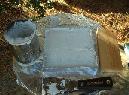
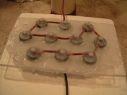
This was barium titanate mixed with mineral oil and sandwiched in wax. The
idea was to apply high voltage DC across it and test for weight change. None
was detected. I didn't measure dielectric constant. Click on the photos for
larger versions.
|
Barium Titanate and Wax Flat Plate Capacitor - K=12.5 to 18.6 (Sept. 9, 2004)
|
|
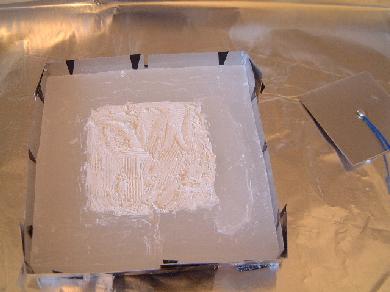
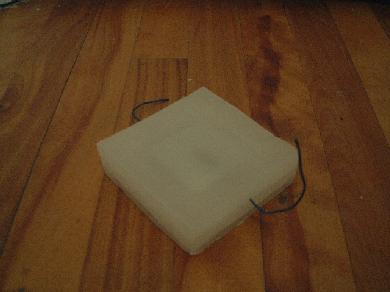
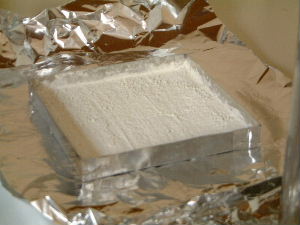
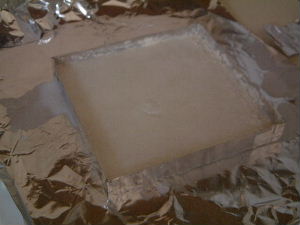
This was
barium titanate mixed with paraffin wax and placed in a
flat, square box-like mold to make a flat plate capacitor
for doing a propulsion test. A relatively good K of around
12.5 to 18.6 was gotten. Mositure was an issue here, resulting
in low resistance through the resulting dielectric.
|
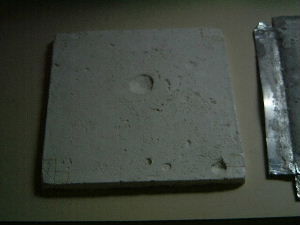
Barium Titanate and Wax Flat Plate Capacitor mess - K=unknown (Sept. 9, 2004)
Barium Titanate Doorknob Capacitor - K=3273 (Oct. 21, 2005)
|
|
This was
a propulsion test for a high K dielectric done by connecting
10 barium titanate doorknob capacitors in parallel. The result was
placed on a digital and power using a high voltage power supply.
No weight change was detected up to around 59.5kV when breakdown
occured around one of the capacitors, but not through it.
|
Barium Titanate and Epoxy Cylindrical Capacitor - K=3 (Apr. 4, 2010)
|
|
|
|
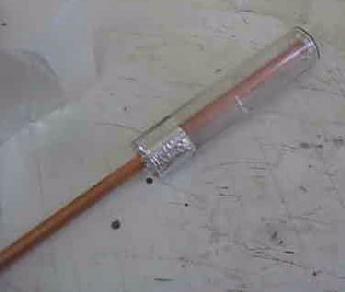
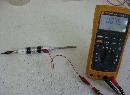
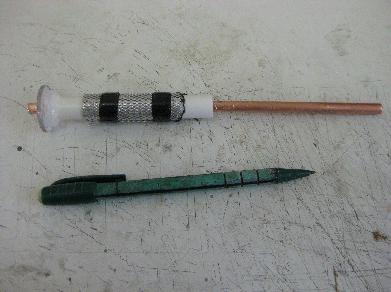
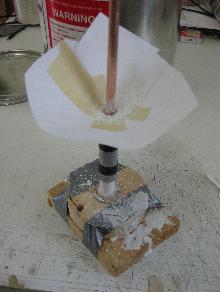
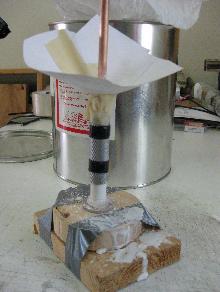
This was a failed attempt to make a cylindrical capacitor. It failed
for two reasons. This first was that the mold was not
circular. It was made of a sheet of acrylic rolled up into a cylinder.
Doing so inevitably leaves an overlapped length inside that does not
follow the curve of the cylinder. The second reason it failed was that
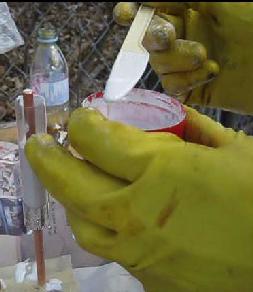
the dielectric constant was only 3. When the mix of barium titanate
powder and liquid epoxy was made, the result in the mixing container
was a thick sludge at the bottom which contained mostly barium titanate
and a white liquid at the top which contained mostly epoxy. As the third
photo shows, I used the epoxy rich but barium titanate poor liquid by
dripping it into the mold. This resulted in a dielectric made mostly of
the low dielectric constant epoxy.
|
Barium Titanate and Wax Cylindrical Capacitor - K=2 (Apr. 8, 2010)
|
|
This was another failed attempt to make a cylindrical capacitor. It failed
for much the same reason that the previous attempt did, the dielectric
constant was too low and for much the same reason. I was aware from
the above successful flat plate capacitor made back in September 9, 2004
(K=12.5 to 18.6)
that I wanted the thick barium titanate and wax sludge but as
soon as I tried to push some down into the cylinder, it cooled and
hardened. It happened too fast for me to pack it in properly. So then
I quickly removed the mess and put my mixing bowl itself on the stove.
I brought the mix to a boil, hoping that would cause a lot of barium
titanate to mix well with the wax. I then poured that into the cylinder
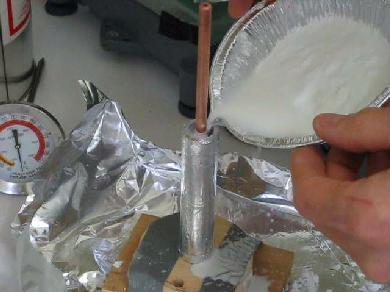
as a liquid. But if you look closely at the photo
you'll see that the thick sludge is still in the mixing bowl while I'm
pouring in the liquid which is still mostly wax. The result was
a dielectric constant of only around 2.
|
Barium Titanate and Epoxy Cylindrical Capacitor - K=15 (Apr. 15, 2010)
|
|
This was my first successful
barium titanate cylindrical capacitor, one with a decent
dielectric constant of 15. It was a mix of 80% barium titanate
and 20% epoxy. The key was to push the sludge down into the cylinder
and tamper it (pound on it with a blunt stick) to pack it in.
The curing time on this epoxy was
over 20 minutes so I had time to do this process, unlike with a
wax sludge which hardens almost instantly on contact with the
cylinder walls.
|
Barium Titanate Powder by Itself - K=5 (Apr. 19, 2010)
Barium Titanate and Epoxy Cylindrical Capacitor - K=27! (Jun. 12, 2010)
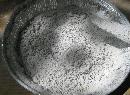
Small ball mix.
 |
|
Winged visitor.
 |
|
Since working out the process, I've made a few cylinders using the same
mold as in the April 15, 2010 entry above. But this time while mixing
the barium titanate and epoxy I kept cutting it into smaller and smaller
pieces, repressing it together, cutting again, and even added more powder
at one point. I ended up with mostly 1mm or smaller diameter balls
with 86% barium titanate. I dropped them into the mold a little at a
time and tamped (pressed) them down firmly before dropping in more.
The result was a K of 27!
|