The Theory
For each of the two small testatika units and the 50cm disk unit there are
two canisters, frequently refered to as pots. The contents of these pots
are largely unkown. The only person reported to have seen inside was Stefan
Marinov and he saw inside only the pots for one of the small units. He said
the following:
|
The capacitors have a cylindrical
"grid", cylindrical plastic insulation
and a copper spiral in the center... THAT'S ALL! I saw in one of the small
machines and there are no magnets. - Stefan Marinov 9/4/90
|
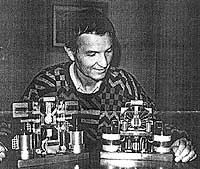
Stefan Marinov with the two small units. Picture
from
this website.
 |
|
Further evidence of the presence of grids comes from the
report from the visit of 30 engineers to the Methernitha community
where near the bottom of the report, the following is said of the 50cm disk unit
(the 3kW machine):
"In the large capacitors there are 20 layers of perforated sheet (Baumann said)".
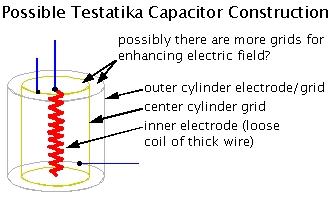
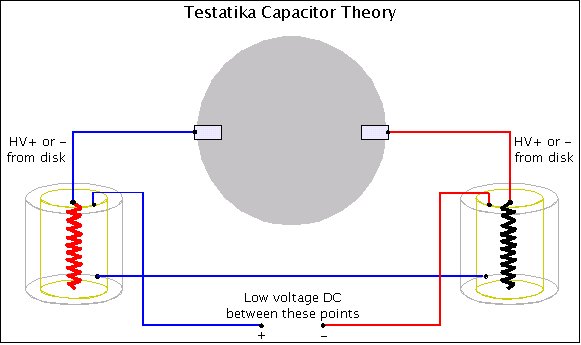
Could the much larger pots in front of the 50cm disk unit also be
capacitors? Assuming they are, from what we know of the pots for the
small machine and the wiring of the 50cm unit, the following is what
I propose they look like inside:
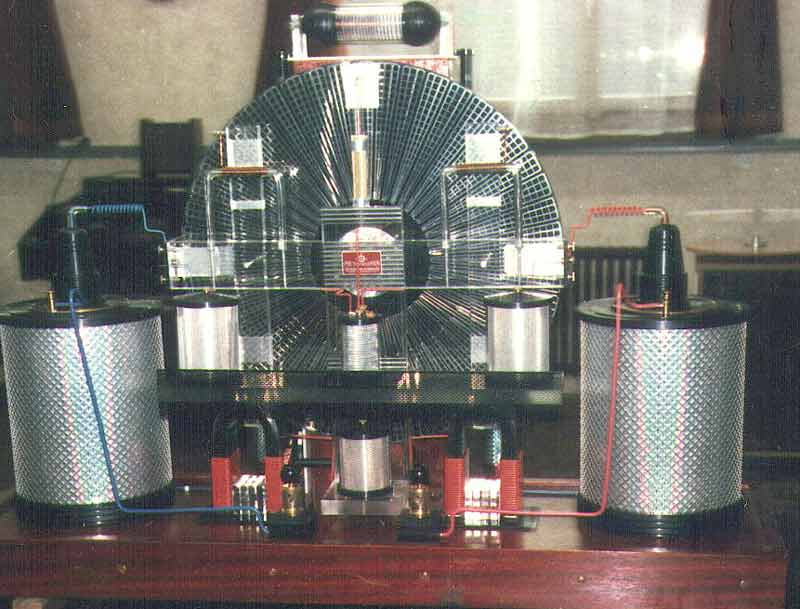
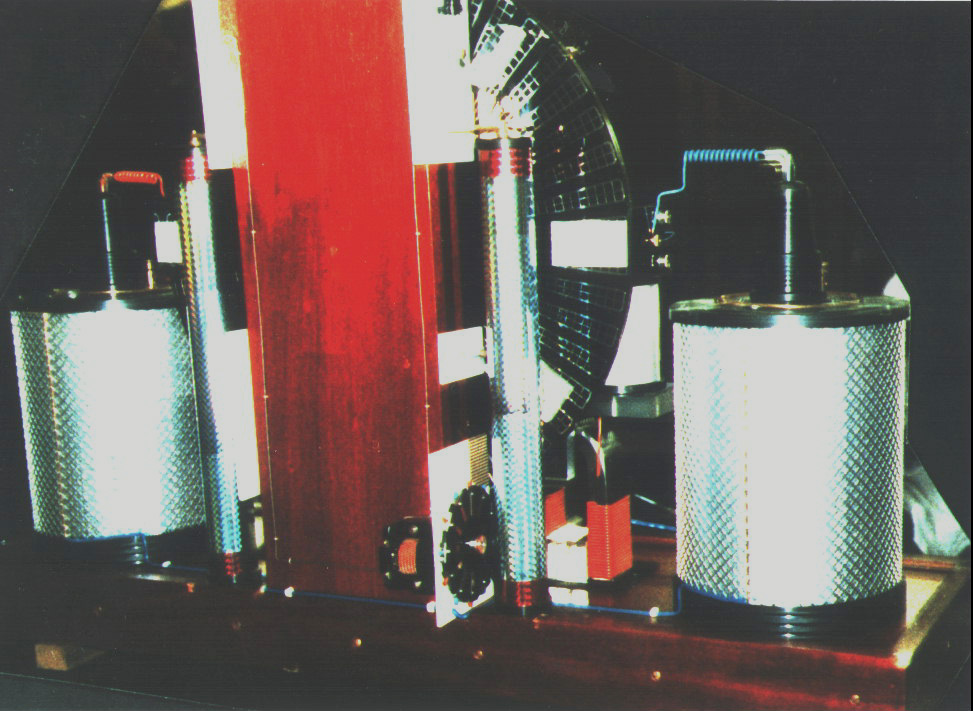
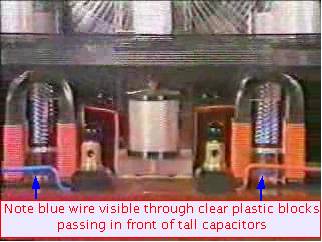
The wiring information can be gathered from the following front and rear views
of the 50cm disk unit (click on the pictures to see the originals):
Given the above, I propose the following theory.
The two electrodes of each capacitor produce a high potential electric
field between them. In between the two electrodes are one or more cylindrical grids
(the yellow cylinders in the picture above represent one grid in each capacitor).
These are what the low voltage DC output is taken off of. If the disc is producing
HV - on one side and HV + on the other side then the electric fields in the
capacitors are not identical so there is a potential between them.
What actually would happen is that as soon as you connect
the two low voltage DC outputs together the potential between them will
vanish. The trick will be to keep this from happening by pulsing the HV.
If the disc is producing the same polarity on both sides then something
extra will have to be done in the capacitors to produce a potential between
them, perhaps having different number of intermediate cylindrical grids or
something else. Further discussion of this idea of the
disc giving the same polarity on both sides can be found here.
Testing the Theory
- Testatika pots as capacitors (mk1) testing (March 2005) -
This one succeeded in getting low voltage DC between the two outputs
but only by having one of the center grids be leaky with the
corresponding output electrode. Something interesting
was found and that was amplification of AC that
was riding on the DC.
- How DC might be gotten from the pots (September 2006) -
This tests having two pots, both getting the same polarity from the disc,
and both with two intermediate grid cylinders, but with the output
being taken from one grid cylinder in one pot and the other grid cylinder
in the other pot. The results look good but more testing is needed on a
future version with higher voltage and more grid cylinders.
- Testatika pots with spark gaps driven by Wimshurst machine (December 2006) -
This tests the effect of a spark gap at the top of each pot, much like the
EV Gray conversion switching tube. The spark gaps were driven by a Wimshurst
machine. The results were DC voltage spikes but only when the output was taken
between a single pot and ground. The ouput across the two pots was AC. Enough
energy was taken off in order to weakly charge a capacitor but nothing
significant.
- Testatika pots with spark gaps driven by Wimshurst machine (February 4, 2007) -
New tests were done with the capacitor (the load) in the same location as
loads are in the real testatikas, between the outputs from the two pots.
This is the same webpage as the above December 2006 tests but it has been
completely revamped.