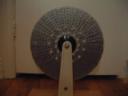
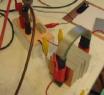
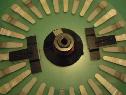
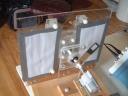
The objective of these experiments is to try to build a testatika or at least
something that works (taps some energy source to produce useful output)
by trying to duplicate the testatika.
The testatika is a free energy device often suspected of being similar to a
Wimshurst machine or an electrostatic machine of some sort. See the
overview page for a more complete description.
|
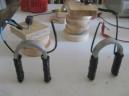
Dissimilar metals testing 1 (Jan./Feb. 2005):
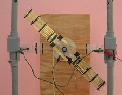
Volta's contact law says that when two dissimilar metals are brought
into contact with each other, a voltage appears between them.
Testing was done to see if this would
make a difference if the metals were brought close together, as may
be happening in the testatika when different metals are rotated close
to each other. Results: There was a
voltage fluctuation. However, as was learned with the small machine
testing below, this may be a normal result of variable capacitance
which you may have with the same metals too.
|
|

|
Testatika pots as capacitors theory 1 and
testing (Mar. 2005):
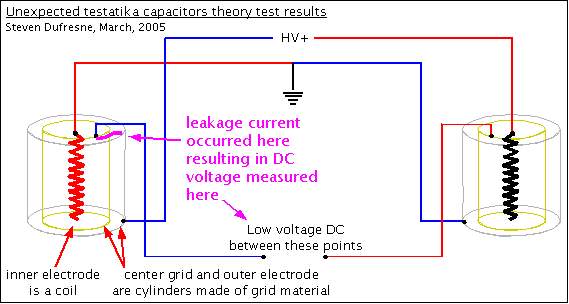
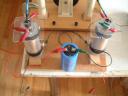
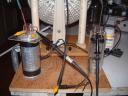
Theorizing and testing were done regarding what might be in the
testatika pots (cylindrical grid capacitors).
Results: This testing unexpectedly
found a way that lower voltage DC output is possible if high voltage
DC is the input. The testing also had some low voltage AC riding on
the DC input which was amplified. This is all possible if there is
ionization in the air between one of the capacitor electrodes and the
output grid. This ionization provides a current path which is the
source of the DC.
| |
| |
For work done on testing to see if the testatika pots could be
capacitive tranformers go to
http://www.hcrs.at/KAPTRAFO.HTM.
For English translation, go to
altavista's translation
website and paste in the address
http://www.hcrs.at/KAPTRAFO.HTM.
|
|
|
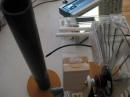
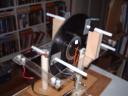
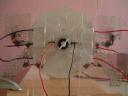
Small Machine testbed 1 (Mar.-Jun. 2005):
Replication was tried of one of the small machines taking an approach
of testing and learning about each component as it was added.
Testbed 1 was the first version but it suffered from a disk that wobbled
too much. As well, due to lack of experience using an oscilloscope to
measure something that had a floating voltage (neither electrode grounded),
all the measurements were done incorrectly - one of the electrodes was
always unknowingly being grounded.
|
|
|
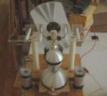
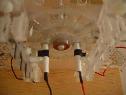
Small Machine testbed 2 (Jul.-Aug. 2005):
Improvements were made to testbed 1 to create testbed 2, making it
possible to eliminate much of the disk wobble and adding other adjustability
improvements. From this, and by using the oscilloscope correctly for floating
voltages, a better understanding was gotten of what
was going on.
Results:
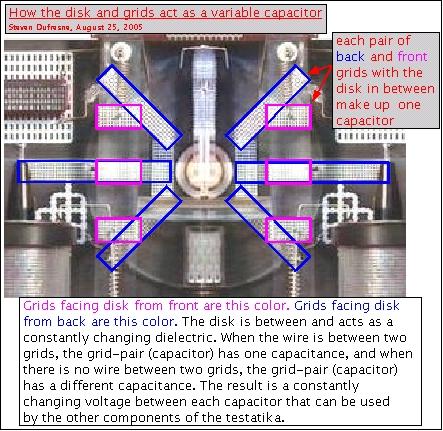
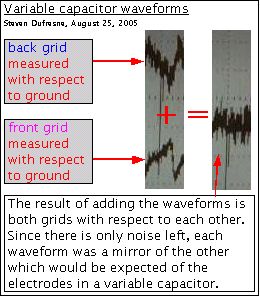
The purpose of the disk in this machine is to
be a variable dielectric for all the grids that face the disk. These
grids act as variable capacitors, their output being an alternating
voltage (something that has long been suspected). The following diagrams
illustrate this and the experiments can be found
here.
| |
| |
Further confirmation of this can be found from
results of this testing by another group.
This alternating voltage
should then be used as input to the components which somehow produce the
increased power.
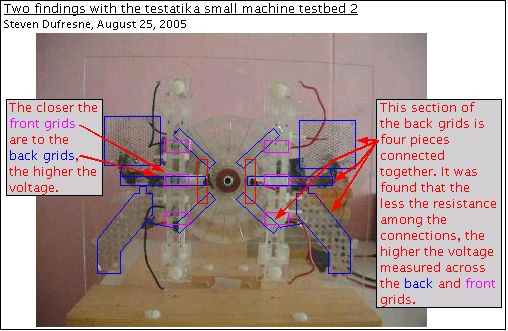
Two other results are illustrated as follows:
| |
| |
However, the design of testbed 2 was still too unstable as the wobble
would return if it was knocked too hard, resistance was an issue in
the back grids, and other problems made it so that constant readjustment
was needed and the same precise measurement could never be gotten two
days in a row (though the electrical behaviour was consistent).
The main problem, though, was that only about
20mV to 50mV spikes were gotten from of the disk. At least 700mV was needed
so that a modern diode could be used to charge up the grid capacitors.
Creation of diodes by wrapping coils around magnets
(see Tesla's US patent 413,353 "Method of Obtaining Direect from Alternating
Currents") was tried but none of these efforts produced any
rectification.
|
|
|
|
|
|
|
|
|
|
|
|
|
|
|
|
|
|
|
|
|
|
|
|